fragmented team operations
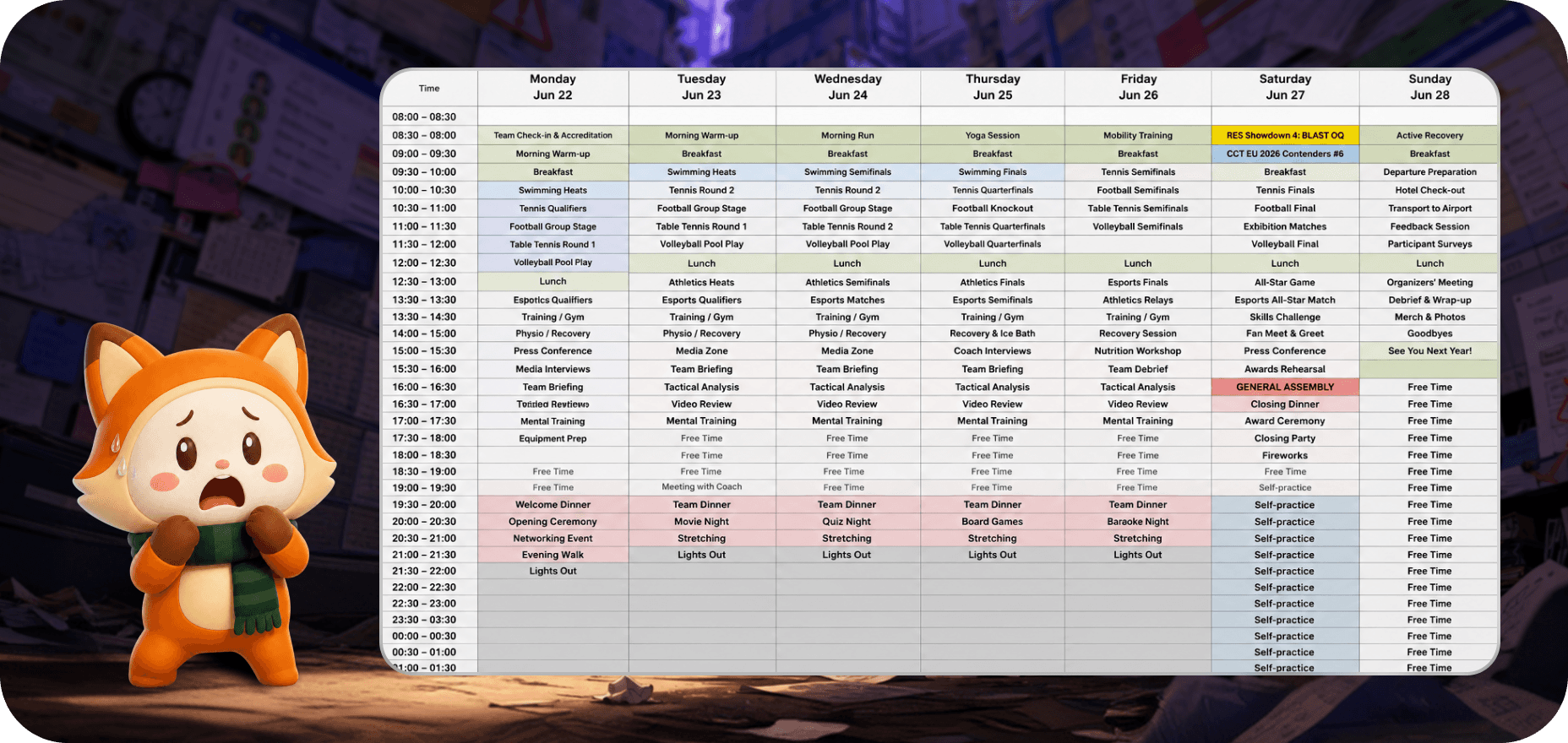
BAKS Esports managed player condition, schedules, coaching tasks and match reviews across chats, spreadsheets, calendars and demo tools. A single issue could move from a demo to a message, then to a task and practice without a persistent link—losing its source, owner and result along the way. Coaches had to reconstruct the context manually, while the club could not build a shared history of decisions and progress.
We defined success through daily check-in completion, the time from an identified signal to an assigned task, task review cycles and the share of match findings completed in practice. The first goal was to improve the workflow inside BAKS; the longer-term hypothesis was to turn the validated system into a subscription platform for other CS2 teams.
a player is more than statistics
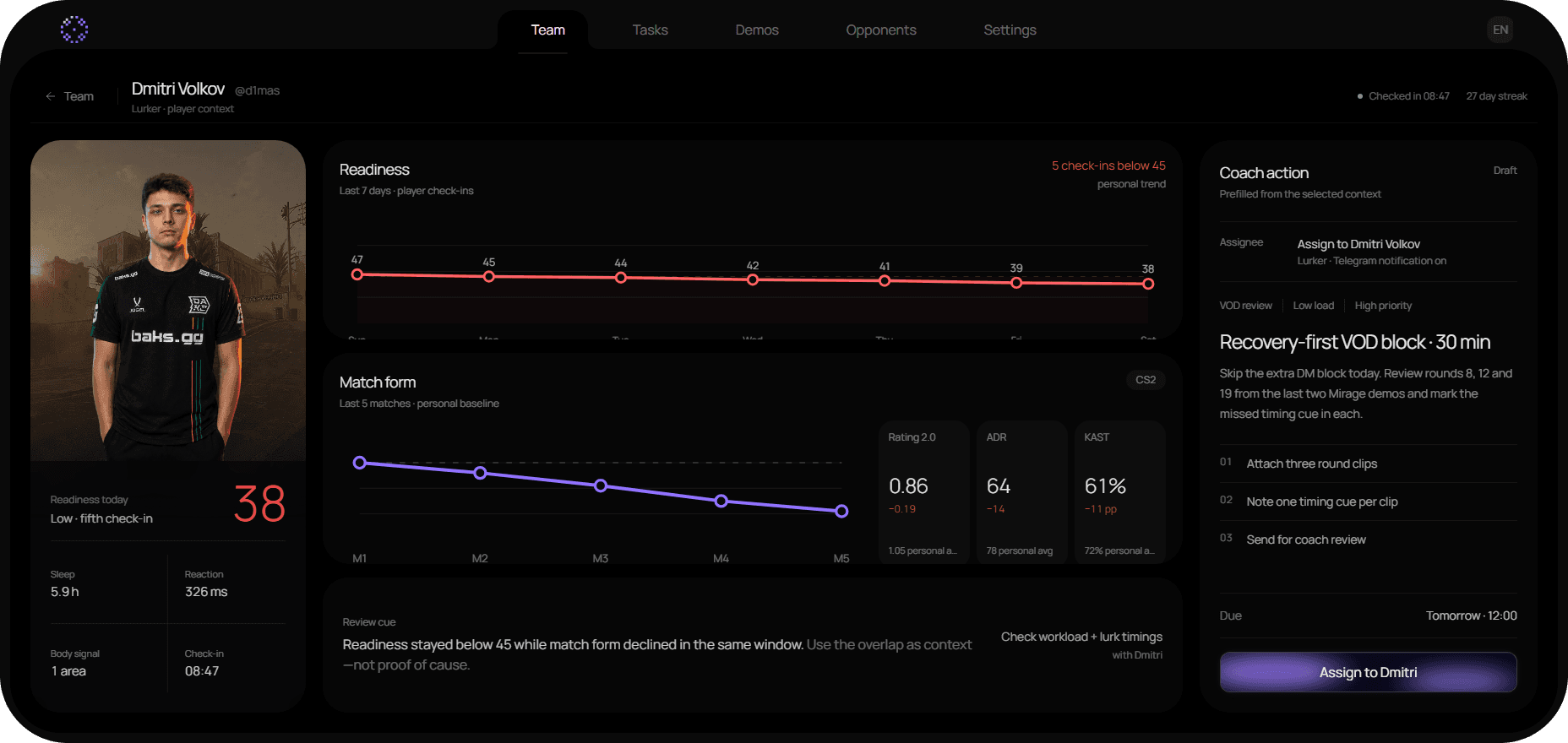
The platform connects three layers of data usually reviewed separately in esports. A five-step check-in captures sleep, mood, energy, physical condition and perceived readiness; reaction tests add an objective performance signal; WHOOP contributes recovery data; and parsed demos show what happened in the game. Together, these inputs build a longitudinal view of the player’s physical and psychological state. The model was shaped with input from a psychologist to reveal patterns—not diagnose them.
This brings the logic of high-performance sport into CS2. The coach can compare how the player felt, how the body recovered and how they performed, then adjust workload, training focus or the next action. The score points to where attention may be needed; the underlying evidence remains visible, and the coach makes the decision.
the coach’s daily workflow
Every role has its own view and level of access: players follow their daily plan, psychologists work with wellbeing, and club administrators manage people and permissions.
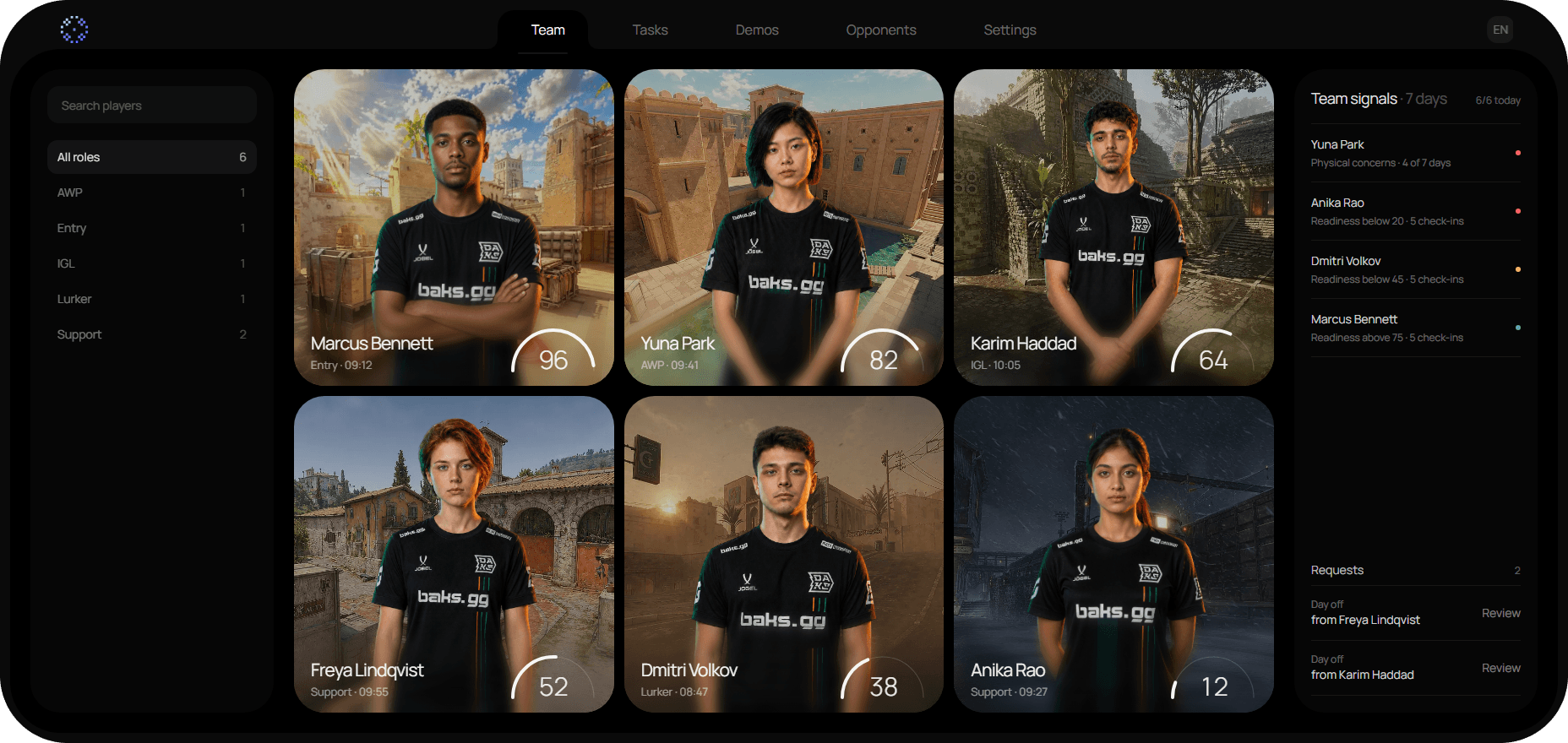
We designed the coach view around a repeated daily workflow: scan the team, open a signal, review the player’s context, choose an action and later check the result. Team overview, player profiles, schedules, tasks and practice remain connected, so the coach does not have to reconstruct decisions across chats, spreadsheets and personal notes.
The system highlights changes and unresolved issues, but it does not prescribe a response. The coach decides whether to start a conversation, adjust workload, assign a task or schedule practice—managing the whole roster while keeping every plan individual.
tasks built around the day
The task system turns coaching decisions into a plan organised around the player’s day. The daily view shows only what matters now—sessions, deadlines and assigned work—in a clear sequence. The full list brings together individual and team tasks, one-off and recurring routines, priorities, owners and completion history.
Each task is an interactive workflow rather than a reminder. It can include instructions, steps, files, deadlines and required proof. The player submits the result; the coach accepts it or returns it with feedback.
Verified completion builds streaks, unlocks rewards and contributes to the bonus system. Gamification keeps motivation tied to meaningful work and long-term consistency. This closes the loop from a coaching decision to an assigned action, a verified result and the next individual decision.
game data with player context
Each demo is automatically parsed into a match rating, a round-by-round timeline and player-level evidence. The coach can move from the final result to an exact round, event or perspective, reviewing positioning, movement, utility and engagements.
Because match evidence lives in the same profile as condition, recovery and workload, the system can compare the player’s state before a match with their performance during it. Over time, it surfaces correlations, identifies conditions associated with stronger or weaker games and tracks factors that may affect consistency.
These patterns provide context rather than proof of cause. Every individual recommendation remains connected to the underlying evidence, allowing the coach to decide whether to adjust recovery, preparation, workload or training focus.
from mistake to practice
Once a mistake is found during match review, the player can immediately open the relevant situation on an internal practice server. The map, position, side, role and original match context remain connected, removing the need to reconstruct the scenario manually.
The player can correct a missed smoke, positioning, movement, timing or site entry, or repeat a complete team execute with the correct responsibilities and sequence. Each situation can be practised until the required action becomes repeatable.
The server records attempts and verifies measurable results automatically. This shortens the distance between understanding what went wrong and building the correct response—so the player is better prepared when the same situation appears again.